SmallCaps Daily Exclusive Interview | Copper One Resources Corp. (CSE: CEXY | OTC: CEXYF)
The world is entering a period in which copper is becoming increasingly critical to economic growth, energy security and technological advancement. From artificial intelligence and hyperscale data centers to electric vehicles, power grids and national defense, the demand for copper is expanding across industries that will define the next generation of global infrastructure.
Yet one fundamental question remains: Where will the world find enough copper?
According to the International Energy Agency's Global Critical Minerals Outlook 2026, projected copper mine supply from existing and announced projects could fall approximately 25% short of global primary copper supply requirements by 2035 under the IEA's stated scenario assumptions. The agency has also highlighted declining ore grades, rising project costs and a slowdown in major copper discoveries as significant obstacles to bringing new production online. These challenges underscore the strategic importance of identifying and advancing new copper resources in established mining jurisdictions.
Few industry leaders have been as outspoken about copper's long-term importance as Robert Friedland, founder and Executive Co-Chairman of Ivanhoe Mines. Friedland has repeatedly highlighted the enormous volumes of copper required for electrification, digital infrastructure and national security, warning that discovering and developing new supplies represents one of the mining industry's defining challenges.
Against this backdrop, Copper One Resources Corp. (CSE: CEXY | OTC: CEXYF) is pursuing this opportunity through an expanding portfolio of copper exploration projects across North America. The Company's strategy focuses on acquiring historically producing mining properties and prospective exploration assets, leveraging historical geological data and modern exploration technologies to identify mineralization and unlock potential value.
At the center of its portfolio is the flagship Majuba Hill Copper Project in Nevada, ranked the world's most attractive mining investment jurisdiction in the Fraser Institute's 2025 Annual Survey of Mining Companies. Copper One's growing portfolio also includes the Sport Copper Project in Utah, the Redonda Copper-Molybdenum Project and Redhill Property in British Columbia, and the Sword & Gossan Mineral Properties in west-central Labrador, Newfoundland and Labrador, where the Company has entered into an agreement to acquire a 100% interest.
Together, these assets provide Copper One with multiple exploration opportunities across established North American mining jurisdictions, positioning the Company to advance potential copper discoveries amid growing global demand and concerns over future supply constraints.
Rather than relying exclusively on early-stage grassroots exploration, Copper One is examining historical mining districts where past production, geological records and modern exploration methods may provide a foundation for identifying additional mineralization.
Leading the strategy is David Greenway, President and Chief Executive Officer, who brings more than two decades of public-company management, financing and capital markets experience. Greenway believes copper's growing importance, combined with the economics of historically producing properties, presents a compelling opportunity for exploration companies capable of identifying and advancing promising assets.
SmallCaps Daily sat down with Greenway to discuss the changing copper market, the attraction of past-producing mines, the strategic importance of Nevada, and how Copper One intends to advance its portfolio as competition for future copper supply intensifies.
Let's dive in…
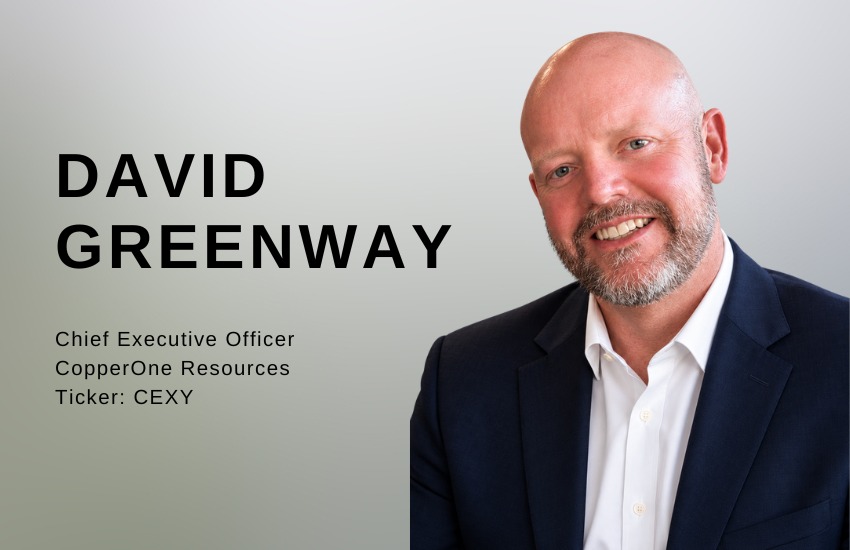
David Greenway – President & CEO
David Greenway is a respected CEO with more than 20 years of experience in corporate management, financing, and growth strategy development across a variety of public companies. Recognized for his strong leadership within the resource sector, he has built a reputation for identifying opportunities, securing strategic financing, and guiding companies through periods of expansion and market growth.
Throughout his career, Mr. Greenway has demonstrated a consistent ability to create shareholder value by combining strategic vision with practical execution. His expertise spans corporate development, capital markets, investor relations, and operational growth, allowing him to successfully position companies for long-term success in competitive global markets.
By leading and supporting numerous publicly listed companies, he has contributed significantly to their advancement, helping strengthen operations, expand market presence, and enhance overall corporate performance.
FULL INTERVIEW:
To start, can you introduce Copper One and explain the strategy behind CEXY’s focus on copper exploration and development?
We got involved with copper because of the price, the demand, and where we see things going. Copper is becoming increasingly valuable, whether you're looking at its use in medical applications, technology, or electric vehicles. You can see how important it is becoming across so many different industries.
We've looked at different opportunities over the years, whether it's gold, uranium, lithium, or silver. But with Copper One, we decided to focus entirely on copper and, more specifically, on acquiring past-producing mines and projects with significant upside potential. We've put together a team of five geologists who go through these projects, conduct their due diligence, and dig through historical reports to identify opportunities.
Majuba Hill, our flagship project in Nevada, is a good example. It's a massive mountain of copper with historical production reportedly averaging around 4% copper, along with silver and some gold. The main focus is copper and silver.
Our strategy is to acquire as many high-grade, past-producing copper projects as we can, develop those assets, and update their resources and NI 43-101 technical reports. We're also in a strong financial position. We're sitting on approximately $15 million to $17 million in cash, having recently closed an $8 million financing. We've got three drill rigs and programs moving forward across our portfolio.
One of the challenges with Majuba Hill is that winter conditions make drilling and exploration significantly more expensive. That's part of the reason we've expanded into other jurisdictions, including British Columbia, Newfoundland, and Utah. We want to be able to advance projects and deliver exploration news throughout the year rather than having everything stop for the season.
We currently have five projects in the company, and we're constantly looking for more opportunities. We're still in the early stages of building the Copper One story, but there's a lot happening across the portfolio.
Copper One's strategy of acquiring past-producing mines is an interesting approach to exploration. What makes these assets particularly attractive, and why do you see an opportunity to unlock their value today?
The copper price is a big part of the equation. Back in January 2016, copper futures fell below US$2 a pound. As of October 2026, we're looking at around US$6.60 or C$9.37. That gives us a reason to revisit projects that previous operators may have set aside. But supply doesn't respond overnight.
And we're not the only ones looking at the potential for higher prices. According to Investing.com, Deutsche Bank's Daniel Ghali has forecast roughly US$10 a pound by the second quarter of 2027. CNBC reported in May 2024 that commodities fund manager Pierre Andurand saw the potential for US$18 a pound over roughly four years. Resource investors Leigh Goehring and Adam Rozencwajg also explored the possibility of US$15 copper in their May 2021 commentary. Those are bullish views, not guarantees, but they show the scale of the discussion. Our approach is to return to properties with historical mining and exploration records and use that information to guide our work. We're not starting from scratch, but we still need to define the mineralization and complete the technical studies to determine whether a project can become economically viable.
A lot of copper companies are focused on a single project. We were originally focused on one project ourselves, but when you factor in the time of year, drilling conditions, and costs, it didn't make sense to limit ourselves. There are simply too many other opportunities out there.
We've seen companies build portfolios of five, ten, or fifteen projects, and the major mining companies take notice. They would rather look at a larger portfolio of past-producing assets. That's what we're doing. We're putting all the pieces together, developing these projects, and making sure we're fully funded along the way. I think it's going to be an incredible next couple of years.
What are some of the reasons these mines stopped producing in the first place, and how does Copper One evaluate whether they have the potential to become viable again?
Some of them stopped because of costs, some because of permitting, and others because of environmental issues or mismanagement. I look at it like a soccer ball with six holes in it. If you can identify those holes and fix each one, all of a sudden you've got a perfectly good soccer ball again.
It's a similar situation with a lot of these mines. There was something that prevented them from moving forward, whether it was the price of copper, environmental challenges, permitting, or the way the project was managed.
Now we have the opportunity to go back, find these assets, figure out what went wrong, and see what we can do to address those issues. We take them on one at a time. Once we've identified the challenges and determined how to move forward, we can start exploring and developing the projects. Everything is slowly coming together.
You mentioned that major mining companies are taking an interest in portfolios of past-producing assets. What kind of attention has Copper One attracted so far, particularly around your flagship Majuba Hill project in Nevada?
We've had over 15 groups visit Majuba Hill recently, including representatives of some large publicly listed mining companies. One individual who has visited is Leo Hathaway, an experienced porphyry copper geologist and former Chief Geological Officer of Lumina Copper. He played a pivotal role in acquiring, advancing and selling the original Lumina copper projects in transactions totalling approximately $1.65 billion. Following his visit, Leo joined our advisory board. There's a lot of excitement around our program. We're drilling deeper to test the extent of the mineralized system, following up on step-out drilling and exploring the breccia pipes.
We're hoping that the expansion work comes together, and we're excited about what the results could show. I think we're going to have an incredible year. Things are getting stronger, and we're looking forward to seeing how the project develops.
Once you've identified and developed a promising copper deposit, what does the path toward production look like? Is Copper One interested in eventually operating its own mines, or is the priority to continue expanding the resources?
That's not our focus at this point in time. We did look at putting a small-scale production facility in place, which would cost us approximately $8 million to $10 million. But right now, it seems more efficient to focus on drilling and expanding the deposit. Copper prices are getting stronger, and we've got a lot of people looking for ore as well. On certain projects, we could potentially ship the ore to nearby facilities.
Going into production ourselves would require a substantial investment, and I think that money is more valuable when it's being put toward developing the projects and increasing the resources. But you never know where we'll be focused in the next couple of years. If the deposits keep getting larger, we could end up doing something interesting. We're keeping those options open.
As Copper One looks to expand its portfolio, how readily available are these past-producing assets, and what does your process for identifying and evaluating new opportunities include?
A lot of these projects are still in the hands of geologists and people who have been in the industry for a long time. When everything started going digital, a lot of the historical paperwork never made that transition. We're getting some interesting calls from old-timers who have information on these projects. They'll reach out and ask if we'd like to take a look, and then they'll send us the historical reports and other information.
From there, we pass everything along to our geologists, who review the material and conduct their due diligence. We normally follow that up with a site visit to walk the property and make sure we like what we see.
Our Sport Project in Utah is a good example. We've identified copper mineralization exposed at surface, and our initial program collected 50 rock grab samples, with the highest returning 1.155% copper. These are selective samples and may not represent mineralization across the property, but they give us a starting point for further exploration. The opportunities are out there. It's really a matter of finding the right projects, doing the work, and advancing them systematically.
How is Copper One approaching project development and financing to maintain a consistent flow of exploration results?
We've hired the right legal teams, we've got the right geologists, and our management team is incredible. We've also got a great group of shareholders supporting us. Now it's a matter of expanding each project as much as we can while making sure we're working with the market and developing everything at the right pace.
One of the big advantages of having multiple projects is that instead of waiting four months for drill results, we can have results coming out on a monthly basis. That's a huge game changer.
A lot of junior mining companies will go out and drill, then have to shut down for the season. By the time the results come out, they're running low on money and have to go back to the market to raise capital. Everyone knows they're desperate for funding, and that's not a position you want to be in.
Our approach is different. We've got approximately $15 million to $16 million in the bank, and we'll continue developing each project while strategically raising additional capital along the way. We want to make sure we never get to the point where we're running low on funds. That's the worst thing you can do in this business.
How much capital does Copper One typically need to invest in a project to reach its development objectives, and what does your exploration budget look like?
We could end up spending $10 million, $15 million, or even $20 million drilling a project. But every time we drill, we step back, get the results as quickly as possible, and evaluate where we go next. We're strategically developing the resource while also drilling step-out holes to look for opportunities to expand the deposit. It's about making sure we're putting the money to work in the right places.
This year, we'll spend approximately $2.5 million on Majuba Hill. Between our Red Hill and Redonda projects, we're looking at spending about $3 million Canadian. We're also working out the budget for our project in Utah, so that number is still to be determined. The important thing is that we're evaluating the results as we go and making decisions about how to advance each project based on what we're finding.
With Copper One currently focused on exploration and resource development rather than production, how does the Company ultimately plan to generate revenue and create value from its projects?
At this point in time, there's no revenue coming into the company until we move toward production. But we've already had groups approach us about potentially entering into joint ventures on our projects. That's one of the key opportunities we're looking at as we continue developing these assets. By bringing in a joint venture partner, we can lower our development costs and take a lot of the heavy lifting off our shoulders.
Ideally, we'd retain an ownership interest in the mine while a joint venture partner provides the funding to bring it into production. That would allow us to maintain an interest in the project and potentially generate cash flow without having to fund the entire development ourselves. That's the golden parachute. At the end of the day, we keep control of part of the mine, our partner funds production, and we're looking at cash flow coming out of it. That's one of the best scenarios you could ask for.
Copper is becoming increasingly important to the modern economy. How do you see the supply and demand outlook evolving, and what could that mean for junior copper exploration companies?
When you look at copper right now, we've had mines shut down in Chile, and we're seeing major supply and demand issues. There's so much demand for copper, and the industry is struggling to keep up.
People don't always realize just how many applications copper has. We're seeing it used in everything from mattresses and clothing to healthcare settings and public transportation. In British Columbia, Vancouver Coastal Health has reported installing copper on frequently touched hospital surfaces, such as door handles and IV poles, because of its antimicrobial properties.
Then you think about all the copper used in airplanes, electric vehicles, military equipment, televisions, computers and everyone's cell phone. Add data centers to that picture: the U.S. Department of Energy says they could consume up to 12% of America's electricity by 2028. Meeting that demand will require investment in power generation and the grid, adding another dimension to copper's importance. It's incredible when you start looking at how much of the technology we rely on uses copper. And we haven't really seen the junior mining market take off the way I think it should. We're starting to see some movement, but I believe there's still an incredible opportunity ahead for junior companies.
I think we're just beginning to see the momentum build—and the next chapter could be the most exciting yet.
Looking ahead, what gives you the most confidence in Copper One's strategy, and what should investors be watching for in the coming weeks?
What I like about Copper One is that we're going back to past-producing mines. We're not trying to reinvent the wheel. A lot of the geology is already there, and we know these properties have produced copper before. That's why I like Copper One, and why I personally invest in it. This is my largest position, and I think it's going to be a home run.
Over the next few weeks, I think we'll start putting out our results, and investors will get a better picture of how large these deposits could be. I'm excited about what's coming.
Thank you for your time.